
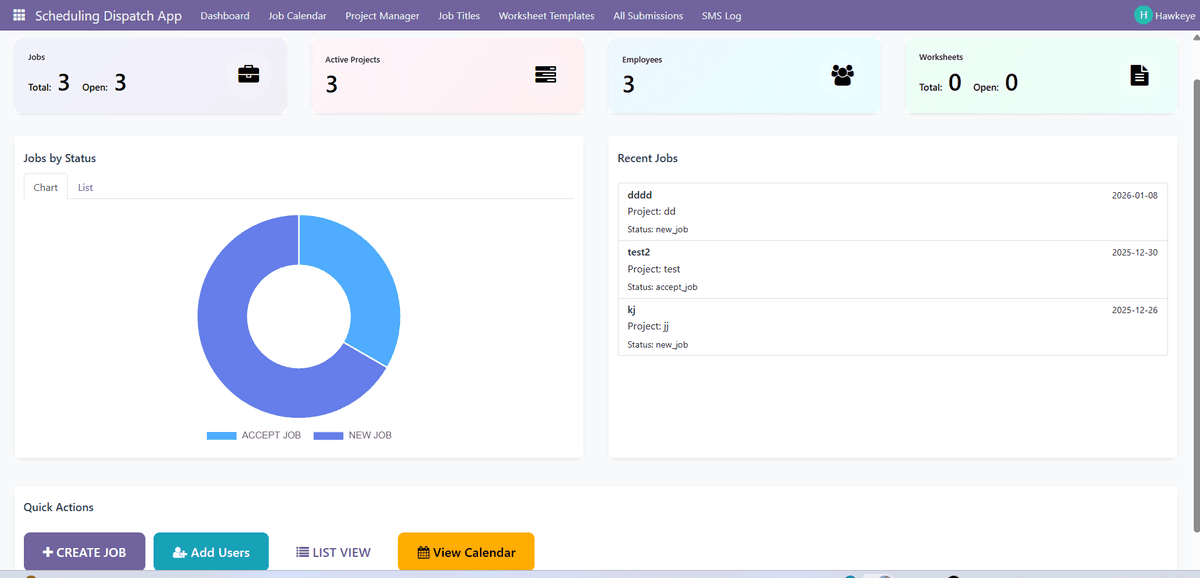
Managing field service operations without proper scheduling and dispatch tools can be overwhelming. Teams juggle spreadsheets, phone calls, and miscommunications that lead to missed jobs, unhappy customers, and wasted time. That's where scheduling dispatch software comes in.
1. Eliminate Scheduling Chaos
Gone are the days of managing jobs on spreadsheets or handwritten whiteboards. Modern scheduling software lets you create, assign, and track jobs from a single dashboard. Your team always knows what needs to be done, where they need to be, and when.
2. Real-Time Job Visibility
See exactly what's happening across all your jobs in real-time. Know which jobs are active, pending, or completed. Track your team's location and progress without constant check-in calls. Managers get complete visibility without micromanaging.
3. Faster Response Times
When a new job comes in, assign it in seconds instead of hours. Automated notifications mean your team gets the job details instantly. No more email chains or miscommunications. Your teams spend time working, not waiting for instructions.
4. Professional Reporting
Automatically generate professional reports after work is completed. Customer-ready documentation is created on the spot. Track metrics like job completion rates, team productivity, and customer satisfaction. Make data-driven decisions to improve operations.
5. Better Team Coordination
Reduce back-and-forth communication. Technicians get clear instructions. Dispatchers see real-time availability. Managers get instant notifications. Everyone works from the same source of truth, eliminating confusion and coordination failures.
6. Accurate Job Costing and Invoicing
When scheduling software tracks time-on-site, materials used, and job status automatically, invoicing becomes a byproduct of operations rather than a separate administrative task. Technicians log completion from their phones. The office generates an invoice in seconds. Customers receive professional documentation the same day work is completed. This speed improves cash flow, reduces billing disputes, and eliminates the gap between job completion and payment collection that plagues manual operations.
7. Scalability Without Adding Headcount
Manual dispatch operations hit a capacity ceiling quickly. A dispatcher can only track so many jobs simultaneously before errors start appearing. Scheduling software removes that ceiling. As your job volume grows, the software handles the coordination, routing jobs to available technicians, sending notifications, tracking completion, without requiring you to hire another dispatcher for every dozen new jobs. Growth becomes operationally sustainable.
8. Customer Satisfaction and Retention
Customers who receive accurate arrival windows, prompt updates, and professional documentation are far more likely to book repeat service and refer others. Scheduling software enables automated customer notifications, appointment confirmations, technician en-route alerts, and follow-up surveys, that create a service experience comparable to large enterprise operators, even for small and mid-size businesses. In a competitive field service market, this professionalism is a genuine differentiator.
Choosing the Right Platform
Not all scheduling dispatch software is created equal. The right platform for a 5-person HVAC company is different from the right platform for a 50-person pest control operation. Evaluate software based on how well it fits your existing workflow, not just its feature list. Look for mobile apps that technicians will actually use, onboarding support that gets your team productive quickly, and reporting that surfaces the metrics most relevant to your business. The best technology is the technology your team adopts.
The Bottom Line
Scheduling dispatch software transforms how field service teams work. You will see faster job completion, fewer missed appointments, more accurate invoicing, and happier customers, all without adding administrative headcount. For service companies operating in competitive markets, the efficiency gains translate directly into higher margins and the capacity to take on more work with the same team. The investment pays for itself through improved operational efficiency and the revenue growth that follows.